
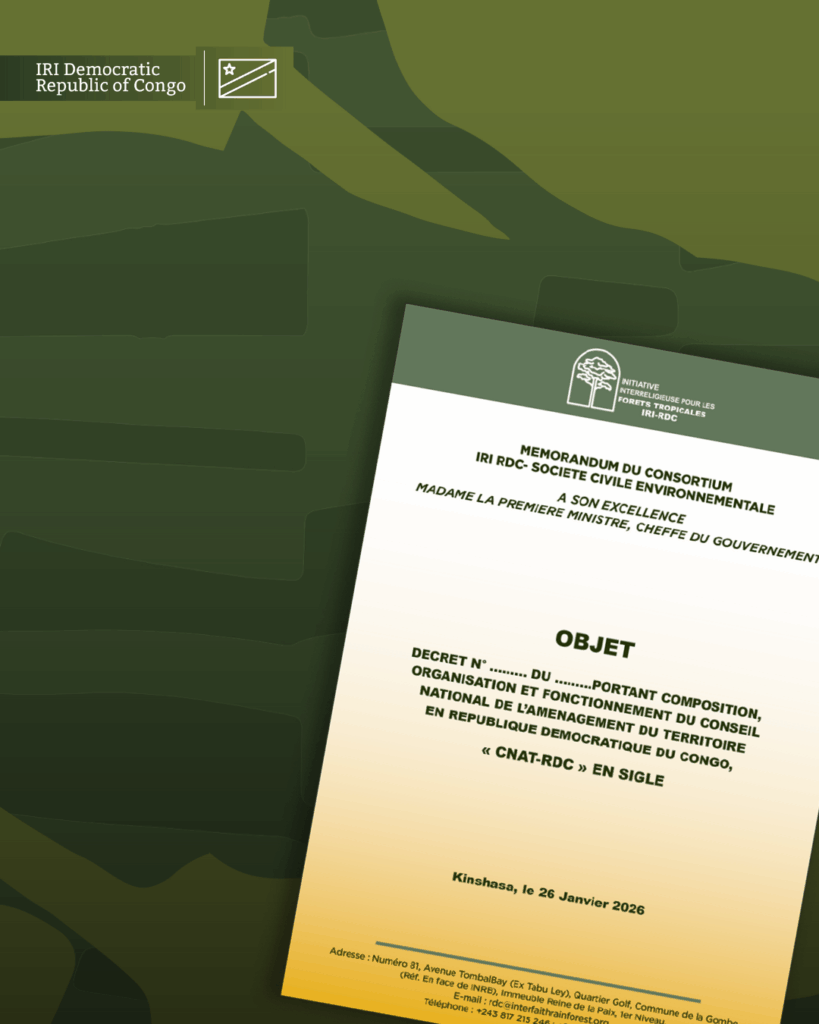
On January 26, 2026, the IRI-RDC – Environmental Civil Society Consortium addressed a formal appeal to Her Excellency the Prime Minister of the Democratic Republic of the Congo, calling for the signing of the decree establishing the National Council for Land Use Planning (CNAT-RDC), as stipulated in Law No. 25/045 of July 1, 2025.
Bringing together religious denominations, indigenous peoples’ organizations, scientists, and civil society actors, the consortium reaffirms its commitment to combating deforestation and promoting sustainable and coordinated governance of national territory. According to the memorandum submitted to the Government, the operationalization of CNAT-RDC is a prerequisite for the validation and effective implementation of the National Land Use Planning Scheme (SNAT), currently under development.
Although the draft decree was approved during the 63rd meeting of the Council of Ministers on October 17, 2025, it has remained unsigned for more than three months. This delay, the consortium warns, undermines the enforcement of land use planning legislation, weakens intersectoral coordination, and limits the State’s ability to arbitrate conflicts related to land and natural resource use.
“Without CNAT-RDC, the governance of the Congolese physical space will remain fragmented, compromising the country’s ambitions for sustainable development,” the memorandum states.
This advocacy initiative is also aligned with the second Letter of Intent between the Government and the Central African Forest Initiative (CAFI), which calls for the establishment of land use planning governance bodies by the end of 2025. For the signatories, this reform is a strategic lever to position the Democratic Republic of the Congo as a ‘solution country’ in the global fight against climate change.
The IRI-RDC reiterates its readiness to engage in dialogue with the Prime Minister and to present the technical, scientific, and community-based contributions of its members, reaffirming its commitment to supporting the Government in the implementation of structural reforms for forest protection and sustainable development