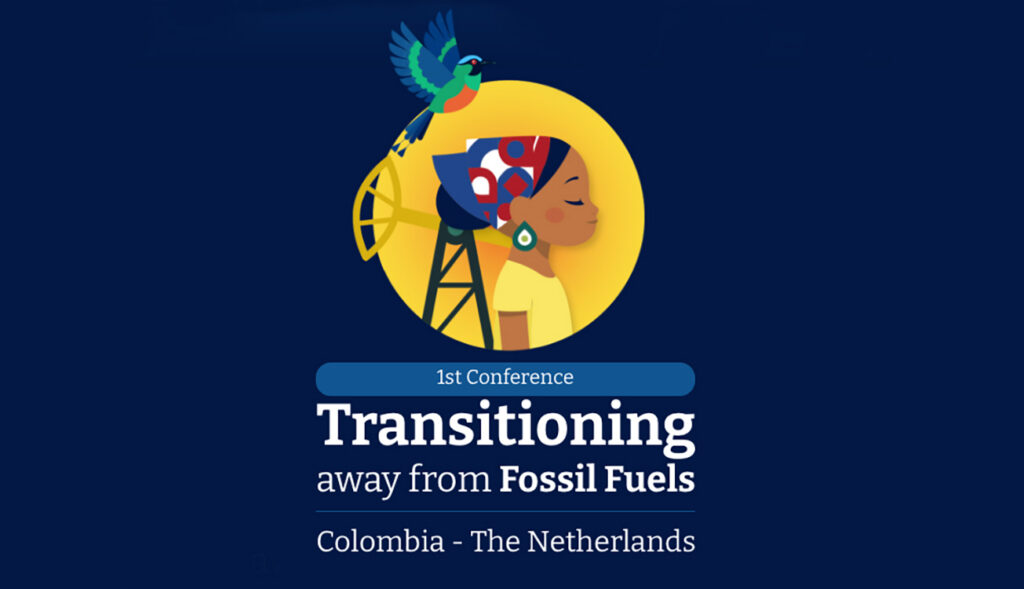

At a pivotal moment for the global climate agenda, IRI-Colombia participated in the discussions leading up to the First International Conference on the Transition Beyond Fossil Fuels, held in Santa Marta from April 24 to 29.
This forum for dialogue, convened by Colombia’s Ministry of Environment and Sustainable Development in partnership with the Government of the Netherlands, brought together key stakeholders from various sectors and regions around the world with the aim of advancing the development of concrete pathways toward a just, inclusive, and sustainable energy transition.
The Interfaith Initiative for Tropical Forests contributed its distinctive perspective to the discussion. This perspective integrates the ethical, spiritual, and territorial dimensions into the climate agenda, emphasizing that the energy transition is not merely a technological or economic challenge, but also a profoundly social and moral process.
One of the main topics addressed during the meeting was the need to move toward energy models that do not reproduce structural inequalities and that ensure that historically excluded communities—peasant, indigenous, Afro-descendant, and rural—are key players in decision-making. IRI-Colombia, for its part, emphasized that the energy transition must be linked to the protection of tropical forests, and that the conservation of water and biodiversity is inseparable from energy policy. Decisions must be made at the local level, integrating scientific knowledge and traditional wisdom, and public ethics and spirituality can play a key role in social and political mobilization, noted Blanca Lucía Echeverry, director of the Initiative.
Multilateralism and cooperation in the face of the climate crisis
This forum reaffirmed the importance of multilateralism in addressing global challenges such as climate change. In this context, coordination among countries, organizations, and social actors is essential for accelerating structural transformations.
IRI-Colombia particularly valued the creation of inclusive spaces that allow for the convergence of multiple voices, recognizing that the legitimacy of climate solutions depends on their ability to represent the diversity of experiences and territories.
IRI-Colombia’s participation in this call for proposals aligns with its mission to mobilize religious and social leaders around the protection of tropical forests and climate action. The transition away from fossil fuels cannot be understood in isolation, but rather as part of a systemic change that must address environmental justice, territorial governance, the rights of indigenous peoples, and cultural and ethical transformations.
Find the full issue of the IRI Bulletin here.