
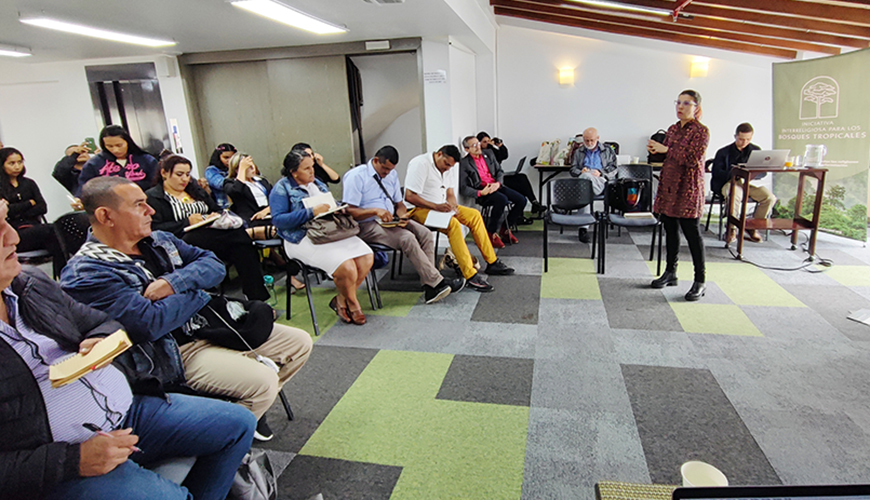
For nine months, Natalia Escobar Viasus has been leading Dejusticia’s Environmental Justice line, where she promotes strategies to guarantee the rights of the most vulnerable populations in the face of environmental impacts. In addition, he represents his organization on the Advisory Council of IRI-Colombia, contributing with his experience to the construction of an interreligious and social agenda in defense of tropical forests.
From an early age, Natalia Escobar Viasus showed a deep interest in territorial dynamics, which led her to train as a sociologist and specialize in Territorial Planning. This vision has guided her professional career as a sociologist, focused on bringing public policies closer to the realities and knowledge of communities, promoting fairer, more participatory and sustainable processes.
“The specialization allowed me to learn about tools on environmental issues and planning, but I wanted to study something that would allow a dialogue between sociology and the territory,” she says about the reasons that led her to do a master’s degree in Geography, with an emphasis on human geography, and to delve a little deeper into the relationships between space, society and nature.
For the Valle del Cauca native, the territory cannot be understood only as a physical or administrative space, but as a living fabric built by the people who inhabit, care for and transform it.

Throughout her professional career, the representative of Dejusticia before the Advisory Council of IRI-Colombia, has delved into two aspects of socio-environmental conflicts: páramo ecosystems and Amazonian deforestation.
Regarding the former, he recognizes that ‘landing’ the technical components of the lines of environmental policy in the territories is very complex, because it often requires understanding the inhabitants of areas with environmental importance not only as social actors who generate a negative impact, but also trying to understand their notions of the environment and their conservation practices.
“In one of my researches, I identified a dialogue between what the communities conceived as a páramo, which is subject to conservation, and its relationship with water. For them, the delimitation of the páramo as an abstract line did not make sense. They understood it as a water network and their place of birth was very important to them. For the first time I heard about the concept of ‘sowing water’ to refer to the recovery of water sources,” she explains.
The second line of work to which he has dedicated much of his professional life, especially since he joined Dejusticia, almost three years ago, is the phenomenon of Amazon deforestation.
“I am very impressed by how an act of transformation of nature is associated with networks – some licit and others illicit; how in itself it generates an economic engine that, in the Amazon, is deeply rooted and has been part of its history, as has happened with the economic bonanzas,” stresses the researcher who has been leading the Environmental Justice line of this organization for nine months.
This is just one of the 13 lines and areas of work addressed by Dejusticia, which celebrates two decades of existence on August 22.
Some of them are Rule of Law, Transitional Justice, Judicial System, Land and Peasantry, Tax Justice and Strategic Litigation, within which the entire legal process that led to Judgment 4360 of 2018 of the Supreme Court of Justice was carried out.
“Within its genesis, our organization has something that it has called amphibious research. This is doing research for action and advocacy. We are a think tank, but not only with the aim of publishing books, but also of taking what we learn to a space of concrete advocacy for social transformation,” stresses the sociologist.
Dejusticia has developed research on the characterization of various drivers of deforestation, including extensive cattle ranching.
In partnership with the Environmental Investigation Agency, it has carried out analyses of the gaps in the meat supply chain, which make it difficult to control livestock activity and its impact on deforestation. In partnership with the UK Embassy, it also developed research on deforestation control, which addresses the legal gaps in punitive policy associated with environmental crimes and their negative impact on the control of deforestation due to livestock farming and on the rights of communities.

Strategic allies
For our organization, says the Valle del Cauca native, it is vital to develop political advocacy actions, since democracy is not limited to elections, but organizations, at their different levels, can contribute to the protection of the Social Rule of Law.
Although it does not carry out lobbying actions in the Congress of the Republic, Dejusticia recognizes that progress can be made in the protection of rights through the approval of laws.
In this sense, the researcher highlights the importance of the bills studied in Congress collecting the voices of local communities and recognizes the ability of IRI-Colombia to reach territories where many organizations do not reach and to have one-on-one communication with the communities.
This dialogue between the Initiative and the territory is important, he says, not only so that the communities are aware of the decisions that already exist, but also to collect their voices and help to know what is happening in the Amazon.
“Those voices should be taken into account in public policy decisions. IRI-Colombia has an enormous capacity to tell what is happening at the local level. Having them as allies, who know and dialogue with the territories, allows us to learn and build that bridge with the communities, which is very valuable for us,” she emphasizes.
Read the full edition of El bosque es vida magazine here (in Spanish).