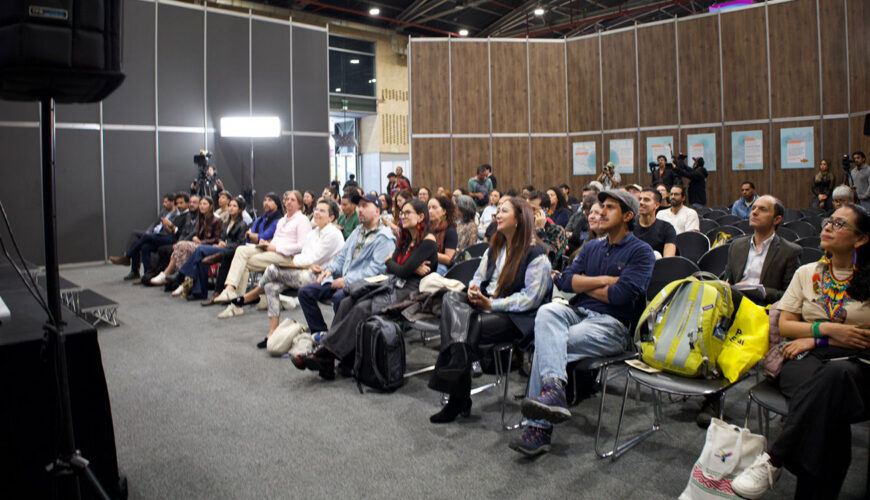

On April 22, Escucha la Amazonía hosted the discussion “The Amazon: A Forest That Speaks” at the Bogotá International Book Fair (FilBo), a dialogue among diverse voices that served as the setting for the launch of the document “Coordinates to Avoid the Point of No Return in the Colombian Amazon,” formulated by the Alliance as a kind of compass to guide conversations and debates about this important region in the context of the presidential elections.
Moderated by Sergio Silva of El Espectador, the discussion featured Fernanda Leal of the Frankfurt Zoological Society (FZS); Sonia Matumbajoy of the National Organization of Indigenous Peoples of the Colombian Amazon (OPIAC); House Representative Juan Carlos Losada; Andrés Zuluaga of The Nature Conservancy (TNC); and Fernando Trujillo of the Omacha Foundation. This diversity of perspectives—scientific, indigenous, legislative, and journalistic—enriched the debate, which reflected the complexity of the challenges facing the Amazon.
During the meeting, the main factors threatening the integrity of the Amazon biome were addressed. Participants analyzed the figures and impact of deforestation and the urgency of adopting concrete measures to halt it, at a time when forest loss is advancing at alarming rates in several of the region’s most vulnerable municipalities.
Another key issue was the growing spread of illegal mining and the serious impacts of mercury use, a highly toxic substance whose contamination affects water sources, wildlife, and the health of the indigenous and rural communities living in the rainforest. The discussion also included a reflection on the fundamental role of indigenous peoples as guardians of the forest, the importance of Indigenous Territorial Entities (ETIs), and the challenges facing their effective implementation. Finally, the panelists discussed the Livestock Traceability Law, its relevance as a tool to discourage deforestation associated with the expansion of the agricultural frontier, and the expected timeline for its entry into force.
Coordinated Efforts to Avoid the Point of No Return
One of the most significant moments of the discussion was the analysis of the actions needed to prevent the Amazon from reaching its point of no return—that critical threshold beyond which damage to the ecosystem would be irreversible. The experts agreed that a comprehensive, urgent, and coordinated response is required at various levels.
Among the priorities identified were: coordination among Amazonian countries to curb illegal gold flows and restore ecological connectivity between the Andes and the Amazon; the expansion of protected areas and the strengthening of peasant reserves; and the effective implementation of Indigenous Territorial Entities (ETI), as well as addressing the backlog of requests for the establishment and expansion of indigenous reserves. Likewise, the panelists underscored the need for a clear and decisive strategy against illegal extractive economies, the guarantee and deepening of a pluralistic and multicultural state, and addressing the structural causes of the crisis, including the lack of governance and inaction in the face of corruption.
The discussion also featured remarks by Juan Felipe Suárez, technical secretary of the Alliance; Carolina Gil, of the Amazon Conservation Team; and Francisco Von Hildebrand, director of Gaia Amazonas, who presented the Escucha la Amazonía document, “Coordinates to Avoid the Point of No Return in the Colombian Amazon,” which includes, on the one hand, an in-depth analysis of the Colombian Amazon, its ecological dynamics, cultural expressions, pressures, and transformations, and, on the other, a set of recommendations and calls to action to address its structural challenges.
Escucha la Amazonía is made up of the Gaia Amazonas Foundation, the Interfaith Initiative for Tropical Forests, the Etnollano Foundation, DeJusticia, the Environment and Society Association, the Foundation for Conservation and Sustainable Development (FCDS), The Nature Conservancy (TNC Colombia), WWF Colombia, and the Amazon Conservation Team.
Find the full issue of the IRI Bulletin here.
 Fernanda Leal, of the Frankfurt Zoological Society; Sonia Matumbajoy, of OPIAC; and Andrés Zuluaga, of The Nature Conservancy.